Building a balanced Fantasy Premier League (FPL) squad isn’t just about picking the highest-scoring players—it’s about managing your £100.0m budget efficiently so you can afford heavy hitters while avoiding weak links.
Understanding squad structure gives you a repeatable blueprint for every Gameweek, helping you maximize your active starting XI while keeping reliable bench options when rotation strikes.
In this guide, we’ll cover the most popular FPL formations, how to distribute your budget across positions, and the optimal bench setup.
1. Budget Distribution: The Core Principles
Before picking formations, you need a clear budget allocation strategy. A common mistake among beginner managers is spreading funds too evenly (“flat structure”), which leaves you unable to afford captaincy-worthy premium assets.
Key Rule: Prioritize your Starting XI. Your bench should contain cheap, regular starters who can step in when needed, not expensive players sitting on the bench unused.
Typical Budget Model:
Goalkeepers (£9.5m – £10.0m total): Either one set-and-forget £5.0m–£5.5m keeper + £4.0m backup, or two rotating £4.5m keepers.
Defenders (£23.0m – £25.0m total): 1–2 premium/semi-premium wing-backs (£5.5m–£6.0m), 2–3 solid mid-priced starters (£4.5m–£5.0m), and 1 budget enabler (£4.0m).
Midfielders (£34.0m – £38.0m total): 2 premiums (£8.5m–£12.5m), 2 mid-priced focal points (£6.5m–£8.0m), and 1 budget starter (£4.5m–£5.5m).
Forwards (£27.0m – £31.0m total): 1 premium talisman (£9.0m–£15.0m), 1 mid-priced starter (£6.5m–£7.5m), and 1 budget enabler (£4.5m–£5.5m).
2. Comparing the Top FPL Formations
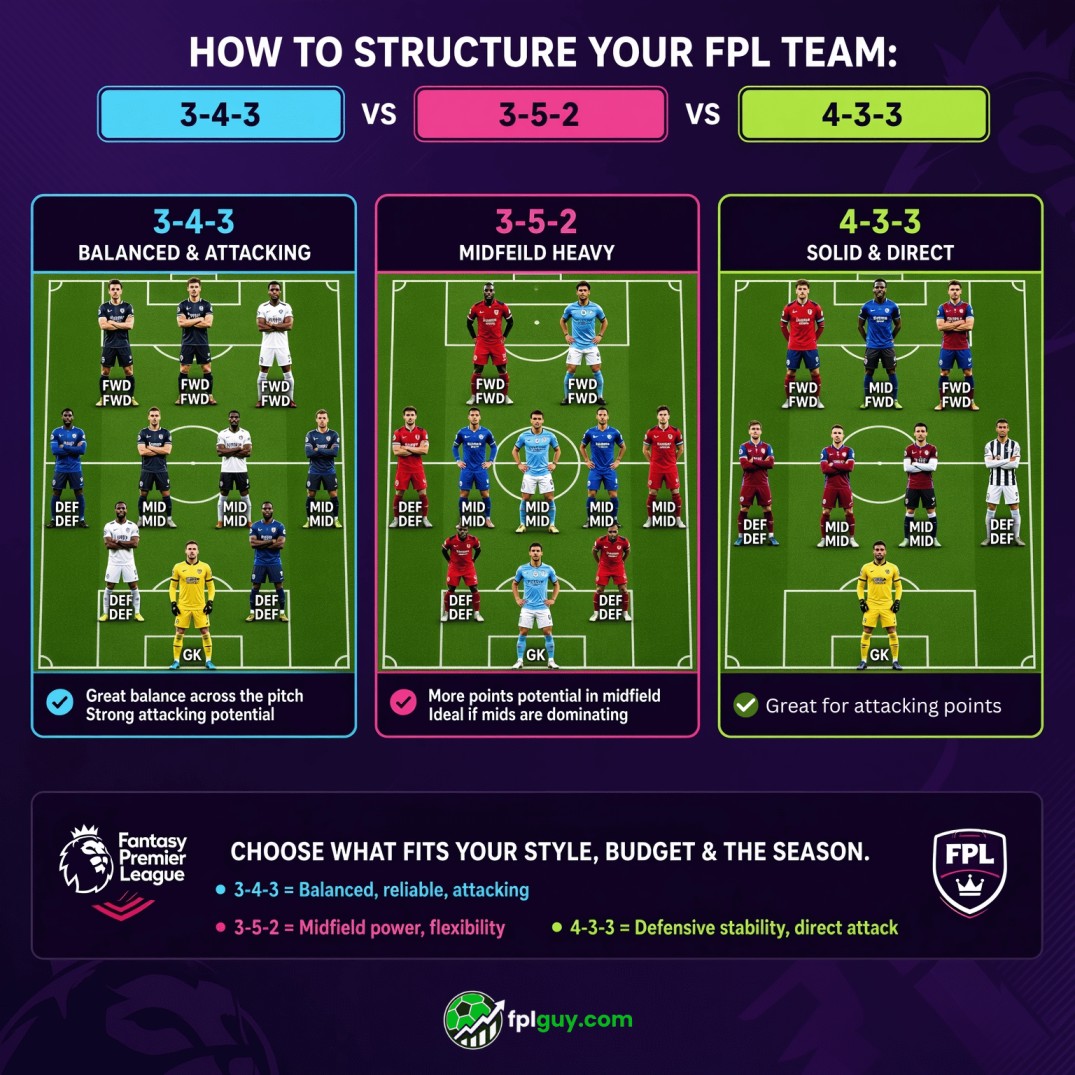
A. The 3-5-2 Formation (The Modern Gold Standard)
Midfielders score more points than forwards for goals (5 pts vs 4 pts) and earn an extra point for clean sheets. Packing your midfield is often the most explosive strategy.
Pros:
Maximizes high-ceiling midfielders who get points for goals, assists, and clean sheets.
Allows room for two premium midfielders and a premium forward.
Cons:
Forces you to bench or play a low-cost third forward.
Best Used When: Midfielders are outscoring forwards across the league and offer better value-for-money.
B. The 3-4-3 Formation (The Classic Attack Approach)
The 3-4-3 has been an FPL classic for years because it maximizes attacking players with high goal involvement.
Pros:
Lets you target three starting strikers with high goal conversion rates.
Very flexible for switching between mid-priced forwards as form changes.
Cons:
Requires sacrificing one spot in midfield, where points-per-million are often higher.
Best Used When: There are multiple underpriced, high-performing mid-range strikers (£6.5m–£7.5m).
C. The 4-4-2 or 4-3-3 Formation (“Big at the Back”)
Investing heavily in attacking defenders from top teams who deliver both clean sheets and goal contributions.
Pros:
Premium defenders (£6.0m) often outscore similarly priced midfielders (£6.0m).
Frees up extra budget to spend on ultra-premium attackers.
Cons:
Defensive clean sheet wipes (conceding late goals) can severely cap your Gameweek ceiling.
Best Used When: Top-four teams have strong defensive fixtures and wing-backs are creating lots of chances.
3. How to Set Up Your Bench Effectively
Your bench consists of 1 Goalkeeper and 3 Outfield Players. Managing this £17.0m–£18.5m corner of your squad properly is what separates top 10k managers from the rest.
| Bench Position | Ideal Price Point | Role / Strategy |
| GK2 | £4.0m | Non-playing or backup keeper to save money. |
| Bench 1 | £4.5m – £5.5m | Guaranteed starter who plays 90 mins (low ceiling, safe 2 points). |
| Bench 2 | £4.0m – £4.5m | Nailed cheap defender or rotation starter. |
| Bench 3 | £4.0m – £4.5m | Fodder (cheapest available player to free up funds for XI). |
4. Key Takeaways for Team Structure
Avoid Dead Money: Don’t leave £6.5m players sitting 2nd or 3rd on your bench every week. Move that extra cash into your starting XI.
Flexibility is Key: Ensure your structure allows you to swap to hot form players in 1–2 transfers without taking hit points (-4).
Adapt to the Meta: If budget strikers are scoring heavily early in the season, adapt to 3-4-3; if midfielders dominate, switch to 3-5-2.